
Imagine transforming an old, forgotten railway network into a seamless, coast-bound cycling adventure. Connecting the rugged, granite mountains of the Portuguese interior to the sparkling canals of the Atlantic coast, the combined route of the Ecopista do Dão and the Ecopista do Vouga is quickly becoming one of Europe’s finest greenway journeys.
Spanning roughly 135 to 140 kilometers, this multi-day ride takes you through deep river valleys, historic steam-engine towns, and eucalyptus-scented forests.
Here is the story, the highlights, and the ultimate guide to conquering this magnificent route from Santa Comba Dão to Aveiro, including the perfect mid-way sanctuary to rest your legs.
The Story: From Steam Engines to Greenways
To appreciate the path beneath your tires, you have to look back at Portugal’s industrial history.
- The Dão Line (Linha do Dão): Opened in 1890, this narrow-gauge railway connected Santa Comba Dão to Viseu, transporting passengers and agricultural goods through the heart of the Dão wine region. It operated for nearly a century before being deactivated in 1988. In 2011, it was reimagined as the Ecopista do Dão—now Portugal’s longest continuous greenway (nearly 50 km), famous for its smooth, color-coded asphalt.
- The Vouga Line (Linha do Vouga): Officially inaugurated in 1908 by King D. Manuel II, this legendary line carved its way through the steep valleys of Lafões to connect Viseu to the coastal hub of Aveiro. While sections of the railway still operate near the coast, the wild mountain stretches have been steadily converted into the breathtaking Ecopista do Vouga.
By linking these two historic paths together via Viseu, cyclists can experience an unforgettable coast-to-ocean corridor.
Stage 1: The Ecopista do Dão (Santa Comba Dão to Viseu)
Distance: ~49 km
The Vibe: Smooth, vibrant, and effortlessly scenic.
Your journey begins at the Santa Comba Dão train station. The track here is painted a brilliant blue, transitioning to green around Tondela and red as you approach Viseu. Because it follows an old train line, the incline is incredibly gentle (under 2%), making it a smooth, rhythmic climb.
Points of Interest & Major Viewpoints:
- Mosteirinho Bridge: Early in the ride, you’ll cross the striking iron railway bridges over the deep valleys, offering beautiful views of the Dão River and its reservoir.
- The Steam Locomotive (Tondela): At the old Tondela station, a beautifully preserved vintage steam locomotive sits permanently on the tracks—a perfect backdrop for a quick history photo.
- Torre de Cambra: A brief detour off the path reveals medieval ruins, ancient pillories, and majestic manor houses that remind you just how old these rural communities are.
Stage 2: Leaving Viseu & Entering the Wild Lafões (The Transition)
As you pass through the historic city of Viseu, you will smoothly transition onto the Ecopista do Vouga. The landscape shifts dramatically here; the manicured vineyards of the Dão give way to the rugged, breathtaking slopes of the Caramulo and Gralheira mountains. You’ll follow the path through São Pedro do Sul, a historic thermal town famous for its Roman baths.
Halfway Sanctuary: Rest & Recharge at Solar da Alegria
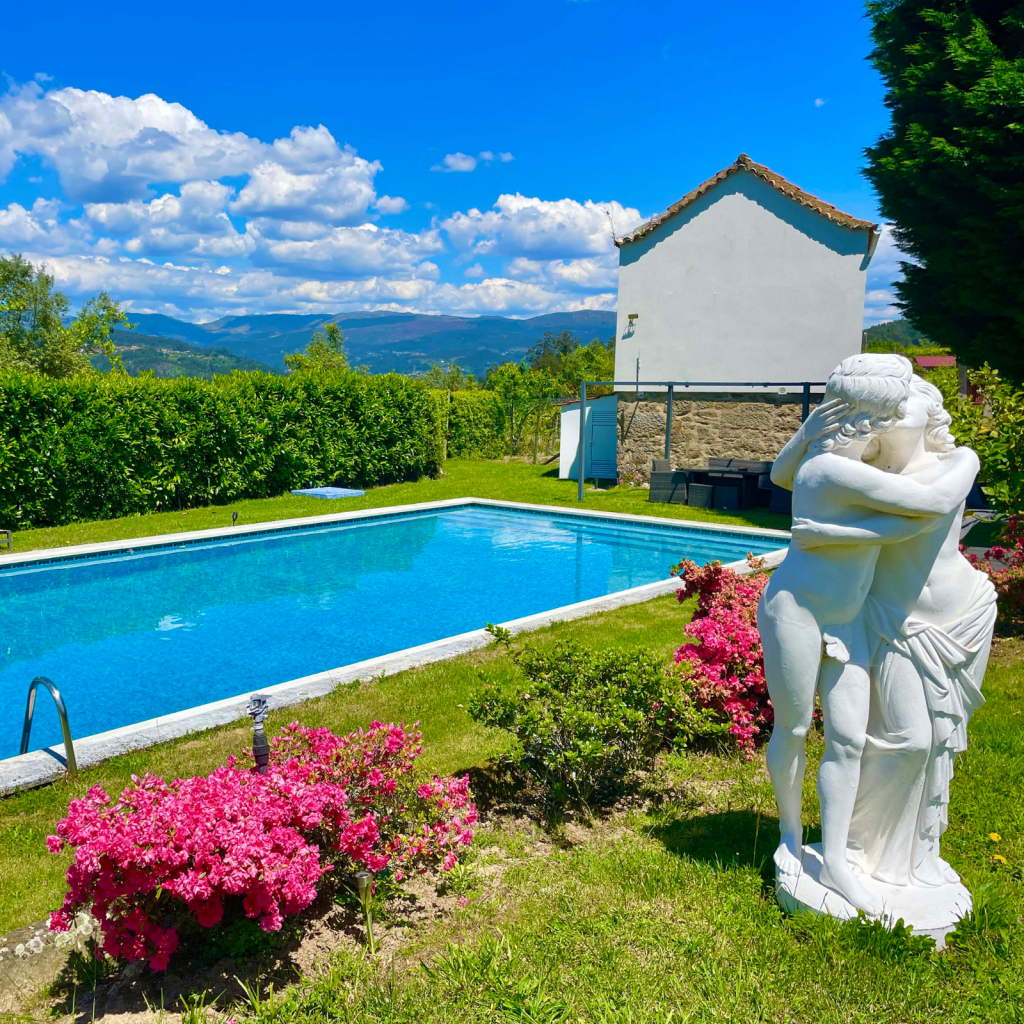
After a long day of pedaling through the mountains, your body will crave comfort. Right around the halfway mark of your grand cross-country journey sits Solar da Alegria—a beautifully restored estate that serves as the ultimate oasis for cycling travelers.
The Ultimate Reward
Upon arriving at Solar da Alegria, there is no better feeling than shedding your cycling gear and diving straight into their pristine, 24°C swimming pool. It’s the perfect way to soothe tired muscles, relax under the Portuguese sun, and gather your energy for the final push to the coast.
The Magical Detour: Baloiço do Rio
Before you unpack, extend your ride just a few minutes further to the spectacular Baloiço do Rio panoramic viewpoint. Swinging high over the water with the mountains framing the horizon is a pure, magical experience.
Stage 3: The Vouga Gorges to Aveiro (The Descent to the Sea)
Distance: ~65 km (varies by connecting routes)
The Vibe: Dramatic tunnels, historic bridges, and salt air.
Leaving your mountain sanctuary, the Ecopista do Vouga treats you to its most dramatic engineering marvels as you descend toward Sever do Vouga and Águeda.
Points of Interest & Major Viewpoints:
- Iconic Railway Tunnels: You will ride through several hand-carved stone train tunnels. Many are now automatically illuminated as you enter, creating a cinematic, cool-air passage through the mountains.
- Poço de Santiago Bridge (Sever do Vouga): This is the crown jewel of the Vouga line. Standing as the highest stone masonry bridge in Portugal, it spans the Vouga River with a majestic, towering arch. The view from the top—looking down at the river beach below—is unforgettable.
- Macinhata do Vouga Railway Museum: A must-stop for history buffs to see vintage train carriages from the turn of the century.
As you approach Sernada do Vouga, the trail flattens completely. You will follow the widening river as the mountain air slowly transforms into a salty sea breeze, guiding you directly into the vibrant, coastal city of Aveiro.
Celebrate your finish line with a traditional ride on a colorful moliceiro boat and a box of sweet ovos moles!
Practical Tips for Your Journey
💡 Bike Choice: Hybrid or Gravel bikes are best. While the Dão section is entirely smooth asphalt, parts of the Vouga line feature packed dirt, fine gravel, or shared ecological tracks.
🎒 Logistics: If you don’t want to carry heavy panniers, coordinate with local bike tour operators who offer luggage transfer services between Santa Comba Dão, Solar da Alegria, and Aveiro.
Whether you are a seasoned cyclist or a slow-travel enthusiast, combining the Dão and Vouga ecopistas is a journey that connects you deeply to Portugal’s landscape, history, and hospitality.
FROM OLIVEIRA DE FRADES TO SOLAR ALEGRIA

 English
 French
 Portuguese
 Spanish
Comments are closed