
By Fatima Teixeira, Music Producer & Sound Healer
I could mention many reasons:
There’s nothing to block it. Nothing is competing with it. No traffic. No Wi-Fi. No electromagnetic interference. No artificial light humming in the background.
In an open desert, sound travels with almost no absorption: dry air and sand reflect low frequencies rather than dampening them. There are no buildings, no vegetation, no urban mass to scatter or block the waves.
At night, temperature inversion layers act like a natural acoustic lens, bending sound back toward the ground and carrying it further than you’d ever expect. And without any background noise floor, even the faintest sound becomes perceptible. Your ears literally open up.
The desert isn’t just quiet.
It’s acoustically alive in a way cities never are.
The acoustic environment is almost incomprehensible to those of us who grew up surrounded by noise.
Your nervous system doesn’t just relax. It recalibrates easily in terms of frequency.
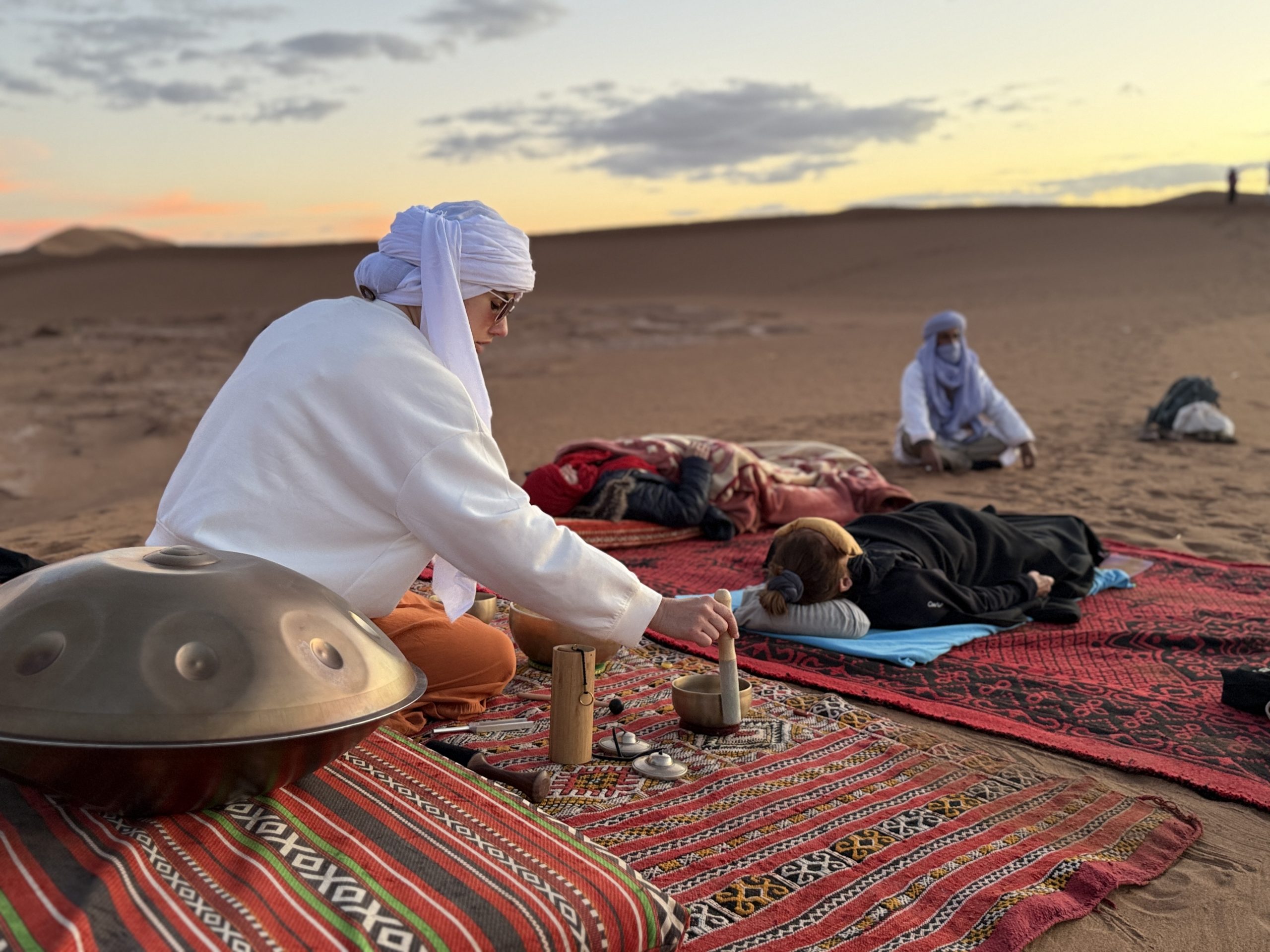
Then something happened during one of the sound baths that I keep thinking about!! Someone was on a phone call on a dune far away from us. And we could hear them clearly. Not distant. Right there, very loudly.
The irony wasn’t lost on me. The one and only time I heard someone speaking on the phone in the desert… it happened during a sound bath. 
But honestly? It was the best possible proof of what that environment does to sound. The Sahara carries everything. The question is what you choose to put into it.
Join the FREE Sound Healing Community: www.skool.com/fatima

 English
 French
 Portuguese
 Spanish
Comments are closed